

Wondering how you can build links that don’t cost excessive time and money?
[lwptoc]Whether you’re new to link building and are wondering where to start, or if you’re a freelancer or agency owner looking for a bit of a refresh, it’s certainly fair to say that link building is going nowhere.
Bbacklinks and overall authority are certainly still some of the primary ranking factors in the world of search engine optimisation. However, even the more reputable digital strategists amongst us can struggle to land the types of links that move the needle.
I’ve put together a link building guide based on what has worked for myself and my clients. This will include some of the strategies you’ve heard before, and maybe some that you haven’t. Either way, I hope that you get something out of this.
Before we start. Let’s get this out of the way. You will need an outreach budget to land quality links. Whether that’s paying for a freelancers time to outreach to relevant website owners, or paying an outreach team to gather data and speak to journalists, you’re going to need to put some budget aside, otherwise this is going to be very hard work (unless you have incredible data to begin with, and even then, you will need to pay for that).
So please, let’s dispel the rumour that you don’t pay for links. You don’t buy links from Fiverr or black hat SEO’s. You do however pay for data, pay for content, and may even pay for inclusion into a reputable site for the purpose of a link. This a world away from buying links off a dodgy PBN seller and hoping for the best.
Rant aside, let’s go ahead with how you can land those sweet, needle moving, client pleasing, cas….Forget it. Let’s have a look.
Journalist Requests
Google is increasingly forcing what were once black-hat SEO’s to be real marketers, and nothing is more original than jumping on PR opportunities at every turn in the hope of a link. This approach isn’t for everyone as it can be time consuming and frustrating, however the payoffs in terms of the types of sites that you can land a link on are huge.
I’ve been featured in sites like The Sun, The Telegraph, Lad Bible and The Mirror, all in the name of shameless self promotion and a link (occasionally, when they decide to actually provide one).
So, how can you find these types of opportunities either for your own PR efforts or for the purpose of building links and drumming up a bit of press for your clients?
Twitter – #JournoRequest
By far the most well-known method is the #journorequest hashtag on Twitter. Slightly spammed a bit more than a few years ago, it’s still a complete goldmine and one of the best places to get in touch with journalists directly (and, more often that not, get a quick reply from them).
There are also a couple of ways that you can speed the process of trawling through countless tweets to find something relevant to you:
Tweetdeck – It’s incredibly simple to use Tweetdeck to filter tweet listings for the types of keywords related to what you’re looking for.
journalistenquiries.responsesource.com/twitter/ I absolutely love this feature from Response Source. It’s essentially an even simpler form of using Tweetdeck (both are great). With Tweetdeck your results are not filtering out the, for want of a better word, shite results. This tool helps to show tweets from only who you want to see them from e.g. only bloggers, or only journalists.
A good 70% of all national press features I’ve landed from clients have come from either direct journo requests, or being able to rapidly message a relevant journalist on Twitter; this tool helps to shorten the process significantly.
Response Source – The link above is a handy free tool from the Response Source site, and the full tool is a massive help when it comes to not only finding journalists or website owners to outreach to, but also as an all-in-one outreach platform.
With Response Source, journalists and website owners will sign up and list their upcoming features, so you can filter by industry and find upcoming features relevant to your client (and then outreach to the appropriate person, creating relevant content for their upcoming features which massively increases the chances of appearing on their site).
You can also send press releases, send mass outreach emails in one go (other tools like Pitchbox are great for this also), and easily acquire journalist information. It might be expensive, but if you’re an agency owner with a team looking for mass outreach options, then it’s certainly worth checking it out. If you don’t have the money for tools, check out hunter.io. The toolbar extension will attempt to find (and, in most cases, successfully will find) the email addresses of contacts associated to the website you’re on. For example, on my site, this is what you see:
This is all well and good but, when does getting a link actually happen?
I hear you. Landing a link through any sort of national press sites can be a difficult thing to do, and even when you get one they’re likely to be no-followed (don’t let this put you off though, as these links contribute to a perfectly healthy link profile overall). Here are the three most common ways of influencing a link that have worked best for me so far:
Links within press releases or pre-written content – These tend to work best on the more specific types of industry sites, for example if you have a client in the engineering sector and you’re outreaching to ancient journalists who don’t know how to remove links from a word doc, so they’ll just keep it in when they paste the press release to their site. Naturally, national press journos can be a lot more savvy, so unless you’re linking to data or a study, you may struggle here (it’s certainly not unattainable though).
Link via image attribution – One of the better ways to either easily get a link, or directly request a link from a press feature. If it’s an image you’ve taken and they’re using it, you need to be attributed. So, directly request an attribution via a link to your site. Again, this doesn’t work every time, but it’s always worth a try.
Link to a study or dataset – By far the easiest way to land a link, especially in press features. If you have a really interesting landing page with a load of stats and data from a survey you’ve done, the journalist or blogger almost has to link to it, otherwise the piece would be pretty much redundant without it. It’s also easier to approach sites who have not linked when you’re guilt tripping them into saying you’ve spent all that time and effort on putting the data together, so the least they can do is link to it!
You then use this page, which will have its own authority because of the referring domains, to pass authority back to the pages that you do want to rank via exact match internal links. This approach is much safer and much more natural than actually shooting a load of links to the pages you do want to rank and hoping for the best…
Link Insertions / Niche Edits
There’s still a bit of an argument on this point, but from testing on my own affiliate sites I’ve seen niche edits work incredibly well. The argument for the effectiveness is that a link within content that is already aged and indexed will be just as, if not more effective than a link coming from a fresh piece of content.
One of the main arguments against niche edits is that, unless the content in question has sustained traffic and authority, the inserted link will not gain any benefit from the insertion.
I’ve seen this work for my sites before, and my advice would be to only get links from sites relevant to your niche, and to not go too exact-match with the anchor text. Generally, if you’re in the market to buy links, you’ll usually find that niche edits/link insertions are cheaper than a fresh post anyway. Food for thought!
Content & Data
I’ve already touched on this point, but I can’t stress it enough. Creating these types of authority landing pages via stats and data then using them to pass authority back to your primary pages is one of the best ways to use outreach to your benefit. You’re creating your own linkable asset in the form of a data piece that, if done correctly, should continue to get data. You then also have full control over the anchor text you use back to the pages you want to rank (and the anchor text can then be updated and amended as required).
So, where do you start with creating this type of content? First, you’re going to either need budget for a survey, or the time to collate existing data and put a spin on it. When it comes to surveys, I’d recommend using something simple like Survey Monkey. When it comes to finding existing data to put a spin on, have a look at Statista.
Often the hardest part of creating this page is landing on an idea that sticks, and something that you know will have a high chance of gaining traction in the outreach arena. One of the best ways to do this is to review existing pages from competitor sites, and look at how you can make these better. You don’t have to reinvent the wheel here either. Try to find pages that have done well in terms of their quality referring domain count (bonus points if they have secured press coverage). How can you make this data better?
For example, for one of my clients I started to research around office hygiene, and noticed that no current datasets or surveys had mentioned hot-desking vs standard offices. And, some of these pages had managed to gain some quality links just off the back of some standard questions.
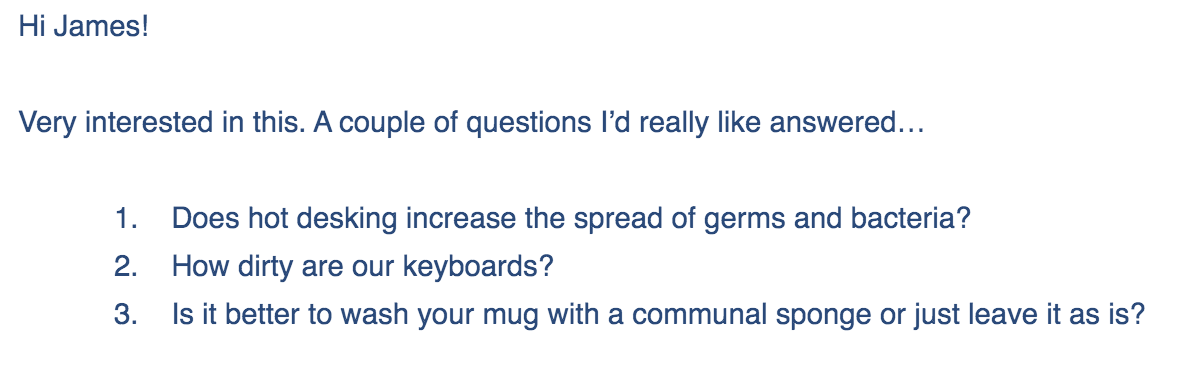
So, I took this idea of office hygiene with the angle of surveying office workers about their everyday office hygiene, with a comparison to how hygienic hot-desking is against the standard office environment. I then used hunter.io to obtain journalist information, and pre-outreached the idea to them in order to ensure that I was on the right track before paying for survey data. Here’s a reply from a journalist from The Metro, one of the sites who my client ended up getting a link from because of the finished piece:
Taking these extra steps may seem like a bit of a chore, but if you can get validation for your idea from the types of people who will be actively linking to you, then it’s certainly worth doing (and can save you a lot of wasted time and budget in the long run).
Infographic Outreach
If you’ve already paid for the data and landed the outreach links you wanted to go after, what’s next? Creating an infographic and putting it on the data landing page will increases the chances of the page appearing in image search results, and also it’s another link opportunity as you can request that any sharing of the infographic requires attribution in the form of a link back to your site (or to your client).
Guest posts
Forever a touchy subject in the world of white hat link building (if there really is such a thing), guest posts aren’t going away anytime soon, so they might as well be addressed. The long and short of it is, they still work well, but you need to be aware of how relevant the site is that you’re going to be publishing a guest post on. If it’s an authority source in the industry and relevant to the site you require a link from, then go ahead. If it’s a site that is actively promoting a ‘write for us’ section, pushing guest posts for money, or accepting posts from any old shit, then stay away.
Also, to be extra careful, stick to naked URLs or branded anchor texts where possible. Exact-match anchors may be more trouble than they’re worth unless you’re completely certain that the site is 100% legit, and that you’re not already over-optimising your anchor text spread.
This also works well for smaller local SEO campaigns too, as once you’ve built up your authority then attempting to rank directly for service terms like ‘Manchester Barbers‘ actually makes sense and is relevant as the authority grows. But, for the first 6 months at least, stick to brand anchors.
Podcasts
Still quite a new strategy in the world of link building, podcasts offer a very natural and logical way to land a link on a relevant site. Whatever podcast you feature on will naturally mention your business and what it is you do, and they will more than likely publish the podcast across multiple platforms. Each site it is published on then means more opportunity for a brand mention, and more importantly, a link.
Conclusion
This has been a bit of a quick overview based on the types of link building tactics that work well in 2022. As search engines inevitably update their measures against manual link building and trends implode within the industry, I’ll come back and update this guide as it necessary.
If you’re struggling with building links for your site or for your clients, then give me a shout either via the contact form or call me on 07393 286 400.
